
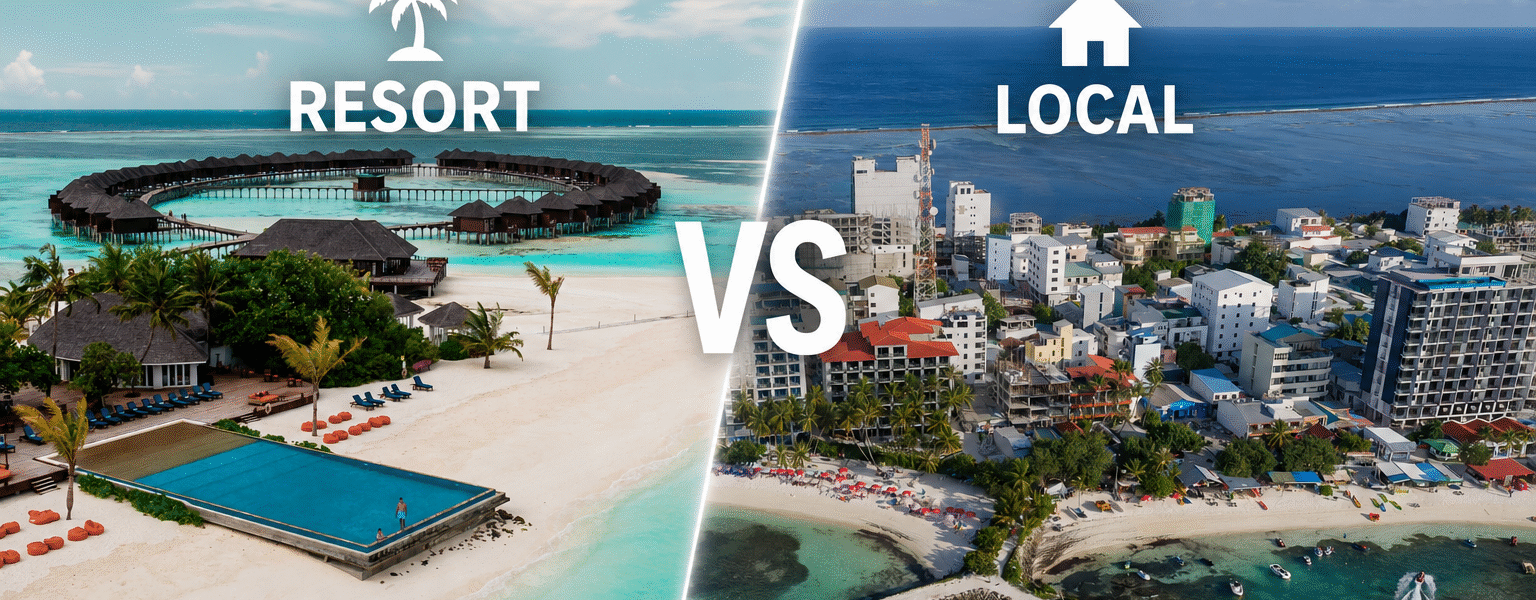
Many photos of the Maldives tell the same story: turquoise water, white sand, an overwater villa stretching into the lagoon. What those photos don’t tell you is that the Maldives actually offers two completely different travel experiences, and the one you choose shapes everything, from your daily budget to what you can wear on the beach to whether you can order a beer at dinner.
So what is the difference between a Maldives resort and a local island? At Budget Maldives, it’s the first question we hear from nearly every American traveler who reaches out before booking. The answer depends on your budget, your travel style, and a few rules you need to understand before you arrive. This article covers the real cost differences, the alcohol and dress code rules, how transfers work, and what your days actually look like in each setting. By the time you finish reading, you’ll know exactly which option fits your trip.
Two completely different Maldives experiences
A resort island is a private, purpose-built tourist destination. The government leases an uninhabited island to a resort operator, who builds everything on it: villas, restaurants, a dive center, a spa. There are no permanent residents, no village life, no mosque calling the faithful to prayer at dawn, and no fishing boats pulling into harbor. Every person on that island is a guest or a staff member. The entire experience is engineered around tourism.
A local island is something else entirely. These are real Maldivian communities where people live, work, send their children to school, and fish for a living. Since 2010, the government has allowed guesthouses to operate on local islands, opening this corner of the country to independent travelers for the first time. When you stay on a local island, you’re a guest in a functioning community, not a bubble designed for your comfort.
That foundational difference drives everything else. The cost gap, the rules around alcohol and dress, the transfer options, and the texture of your days all flow directly from this single distinction: one island exists for tourism; the other is simply a place where people live.
What Is the Difference Between a Maldives Resort and a Local Island: The Real Cost Gap
The numbers here are significant and worth understanding before you set a trip budget. Mid-range resorts in 2026 typically run $400, $800 per night, and luxury water-villa properties hit $800, $2,500 or more per night, often before meals and activities. Guesthouses on local islands run $30, $150 per night, with many solid options sitting comfortably in the $60, $100 range.
When you build out your full daily spend, the gap widens further. At a resort, lunch for one person runs $20, $45, dinner $40, $120 or more, and drinks are billed separately on top of that. Add a snorkel excursion or a spa treatment and a single resort day for a couple can clear $500 without much effort. On a local island, you eat at independent cafés and restaurants where meals are generally a fraction of resort prices, though costs vary widely by island and season, and activities booked through guesthouses or local operators tend to cost significantly less than packaged resort equivalents.
What you pay for at a resort
Resort pricing buys privacy, exclusivity, and seamless all-in-one convenience. You never leave the island to find dinner or book a tour. Everything from the dive center to the sunset bar is within walking distance of your villa. That said, most mid-range and luxury resorts do not include meals, diving, spa, or excursions in the room rate. All-inclusive plans exist, typically priced at $150, $300 per person per day at mid-range properties, but read the fine print carefully to confirm what’s actually covered before assuming everything is bundled in.
What a guesthouse budget actually covers
A guesthouse room gives you a comfortable, private base at a dramatically lower nightly rate. Meals come from local restaurants and cafés around the island, and activities are booked separately through the guesthouse or local operators. The trade-off is that you’re assembling your own experience rather than stepping into one that’s been built around you. For budget-conscious travelers, that flexibility is a genuine advantage, not a limitation.
Alcohol and dress codes: what catches travelers off guard
These two rules trip up more first-time Maldives visitors than anything else, and ignoring either one can cause real problems on the ground. The Maldives is a Muslim nation, and both policies are rooted in that reality rather than being arbitrary tourism regulations.
Alcohol is completely banned on all local inhabited islands. This is Maldivian law, and it applies to tourists without exception. Resorts operate under government licenses that permit alcohol service within their private island premises only. Bringing alcohol into the country is also prohibited; customs will confiscate it on arrival regardless of where you’re heading. If alcohol access matters to your trip, you need to plan around a licensed resort stay or a licensed liveaboard vessel.
The alcohol policy, explained plainly
- Local islands: no alcohol sold, no alcohol possessed, no alcohol consumed. Arrests, fines, and deportation are documented consequences for violations.
- Resorts: alcohol is served within the licensed resort area only and cannot be taken off the island.
- Bringing duty-free alcohol into the Maldives is not permitted; it will be confiscated at the airport.
- The only licensed options outside resorts are certain liveaboard safari vessels and the Hulhulé Island Hotel near the airport.
Dress codes on local islands vs. resort beaches
On a resort’s private beach, standard swimwear is completely fine. Bikinis, swim shorts, and casual beachwear are appropriate anywhere on the resort’s beach and pool areas. The one exception that applies everywhere in the Maldives, including resorts, is topless sunbathing, which is not permitted.
On a local island, the rules shift noticeably. In village areas, shops, streets, and ferry docks, shoulders and knees should be covered. Swimwear is only appropriate in a designated bikini beach area, which many tourist-oriented local islands like Maafushi, Thulusdhoo, and Rasdhoo do provide. These areas are typically marked and sometimes fenced, and they’re usually a short walk from the main village. Wearing a bikini outside that zone can result in a fine or police involvement, according to Maldivian authorities and travel advisories. A practical packing habit for mixed itineraries: carry a light sarong or cover-up whenever you move between island types on the same trip.
Getting from Malé to your island: transfers compared
Transfer logistics are directly tied to your island choice, and the difference in travel time and cost is one of the most practical planning considerations you’ll face. From Velana International Airport, resorts use seaplanes and speedboats. Local islands are reached by public ferry or guesthouse-arranged speedboat.
Seaplanes are the iconic Maldives transfer: a 20, 60 minute flight over coral atolls with views that genuinely live up to the hype. They typically cost $350, $700 per person round trip, operate only during daylight hours, and service resort atolls up to 60 minutes from Malé by air. If your international flight lands late at night, you’ll almost certainly need to overnight near the airport before catching a seaplane connection the next morning, an important scheduling detail that many travelers overlook when booking.
How resort transfers work
Resorts in North and South Malé Atoll use speedboats, which run day and night and take roughly 15, 60 minutes depending on the property. Round-trip speedboat transfers typically cost $100, $400 per person. For more remote atolls in the north or south of the country, the transfer chain involves a domestic flight of 30, 60 minutes followed by a short speedboat leg to the final island. The resort coordinates all of this and includes the transfer detail in your booking confirmation.
How to reach a local island
Public ferries are the cheapest option by a wide margin, often $1, $2 per trip, and they connect regularly inhabited islands on set schedules. The trade-off is time: some public ferry routes take several hours, and the timetable runs on the ferry’s schedule rather than yours. Most guesthouses arrange shared or private speedboat transfers that are faster and more flexible, at a higher cost than the ferry but still notably cheaper than resort transfers. Booking your guesthouse transfer in advance is worth doing, especially during busy season when shared boats fill up quickly.
Activities, beaches, and what your days actually look like
Beyond the logistics, the most meaningful difference between these two island types is the texture of your actual day. A resort day is entirely self-contained. Diving, spa, dinner, evening drinks, and a sunset cruise are all available without leaving the island. You never have to think about what to wear to walk to the restaurant or which operator to book a snorkel trip through. Everything is handled, and the whole experience has a polished, curated quality.
A local island day requires more initiative and delivers something different in return. You choose where to eat breakfast, negotiate a boat trip with a local fisherman, walk through a working village, and maybe end the evening at a café with locals who are genuinely curious about where you’re from. It’s less polished, more real, and for the right kind of traveler, far more memorable.
The resort experience, day to day
Resort amenities typically include an on-site dive center with PADI instructors and structured dive packages (a common format is 10 boat dives for around $350 per person plus taxes), spa facilities, multiple restaurants and bars, a pool, and water sports equipment. Beach access is private and unrestricted, with no dress code considerations outside the resort’s restaurants and public areas. Evening entertainment varies by property but can include live music, themed dinners, and lounge bars.
What a local island trip actually delivers
Local islands offer community-based experiences that no resort can replicate: village walks, fishing excursions, interactions with Maldivian families, and meals at cafés where you’re the only tourist at the table. Many local islands also have accessible house reefs for snorkeling at low cost, and day-trip operators run boat excursions to nearby dive sites and sandbanks. The bikini beach areas are typically smaller and less groomed than resort beaches, but they exist, and they’re perfectly usable. This experience rewards curious, flexible travelers who value authenticity over polish and want more days in the water for less money overall.
How to decide which type of island fits your trip
The choice between a resort and a local island isn’t a quality judgment. Both are genuine Maldives experiences. It comes down to what you’re actually looking for and what you’re willing to work within.
Choose a resort if…
If alcohol access, complete privacy, and seamless all-in-one convenience are priorities, a resort is the clear choice. Resorts are particularly well-suited for honeymoons and special occasion trips where ambiance and service are central to the experience. If an overwater villa with a private deck and direct lagoon access is on your bucket list, that experience exists almost exclusively in the resort category.
Choose a local island if…
Budget is a real factor and you want to stretch more days out of your trip. Local islands make the Maldives genuinely accessible to travelers who can’t justify $600, $1,500 per night for a room. If you’re comfortable with the dress code and alcohol rules and see those boundaries as part of engaging with a different culture rather than an inconvenience, a local island stay will give you something money can’t buy at a resort: real connection with the place and the people.
At Budget Maldives, we’ve built curated packages for both island types across every budget range. Whether you’re looking for an affordable guesthouse on Maafushi with snorkeling day trips included, or a luxury overwater villa with a seaplane transfer, we can match you to the right option based on your travel style, group size, and budget. Our team focuses exclusively on the Maldives, which means hands-on familiarity with properties on both sides of this comparison that general-purpose travel platforms simply don’t have.
Make the choice that fits your trip, not someone else’s highlight reel
The Maldives works beautifully as both a luxury escape and a genuinely budget-accessible destination. The key is understanding which version you’re booking into before you arrive. Resorts deliver privacy, alcohol access, full amenities, and a carefully crafted experience where every detail is managed for you. Local islands deliver affordability, cultural authenticity, and a window into real Maldivian life within a clear set of cultural rules that are worth respecting.
Neither is the wrong answer. The wrong answer is arriving without knowing which one you’re in for. Now you have the full picture, costs, rules, and what each option looks like on the ground. If you’re still weighing what is the difference between a Maldives resort and a local island as it applies to your specific trip, the next step is simple: pick the one that fits your version of the Maldives.
Browse Budget Maldives’ curated guesthouse and resort packages to find options matched to your budget and travel style. Reach out and we’ll match you to the right property based on your budget, group size, and travel style, not just the one that looks best in someone else’s photos.